The instruments changed music. The people changed history.
Fender Electric Instruments looks beyond the famous instruments to the craftsmen, musicians, engineers, friendships, experiments, failures, and relationships that helped create the Golden Age of Fender.
“My Fender book combines history with the people that actually made the history and covers how, where, when, and why. But the who is the focus because, without the people, history would not have happened.”
The stories are tales of the developmental process and the crewmembers who combined ideas and solutions to help change the world.
WHO
PEOPLE
STORIES
HISTORY
The workshop, the workbench, the people.
The featured book · 01
Fender Electric Instruments
The story behind the instruments begins with the people.
This book combines history with the people who actually made that history. It explores how, where, when, and why Fender instruments developed—but most importantly, who was there.
Many stories could only be told by someone who was there and lived the moment. Some stories became myths. Others were simply wrong.
Leo Fender didn’t need to play the guitar to understand musicians.
Leo never learned to play the guitar. He couldn’t even tune one. But he had a lot of musician friends and he spent time at their gigs, watching them work.
Being really observant, Leo learned some of the problems that gigging musicians endured, with the instruments they had, playing on stage for four hours.
He thought that there must be a better way.
“Because he cared . . . And he listened.”
The archive · the people
History remembers the instruments. This book remembers the people.
There are lots of stories about developments, experiments, and, yes, even failures in those early days. But it was those early workers who created the stories.
01
Craftsmen
↗
02
Musicians
↗
03
Engineers
↗
04
Friends
↗
05
Problem Solvers
↗
06
Early Fender Workers
↗
From the archive
In the author’s own words.
A few questions about the people, the process, and the truth behind the story.
How did your personal experiences shape the way you approached writing Fender Electric Instruments?
I was fortunate to know some of the people who were there. I wanted to preserve what I learned from them—the details, the humor, the hard work, and the humanity behind the familiar names.
What do you hope readers understand about the human side of Fender’s early history?
That instruments do not create history by themselves. People with curiosity, patience, and care do.
Which aspect of Leo Fender’s character impressed you most?
He listened. He observed problems closely, then trusted the people around him to help find a better way.
What should musicians and Fender enthusiasts take away from the book?
I hope they enjoy the stories, but also understand the remarkable collaboration and devotion that made the Golden Age possible.
A family story of courage, loss, and endurance.
Book two · a human story
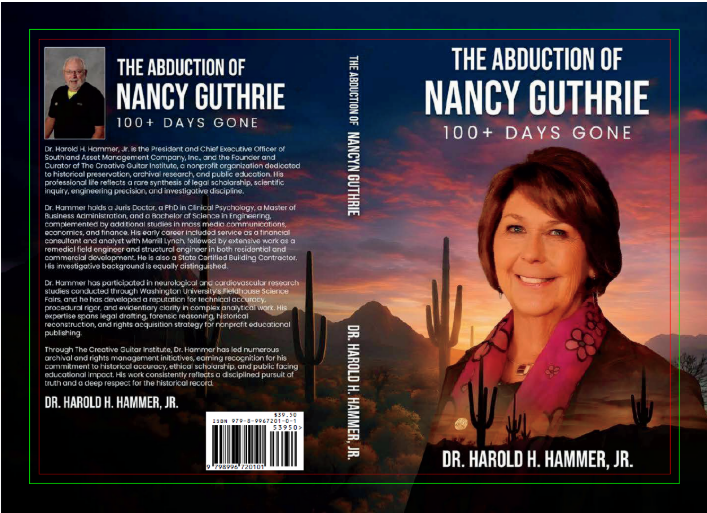
Nancy Guthrie
A family story. A human story.
Nancy Guthrie’s story has respect, understanding, empathy and solace. It is not just a book about a disappearance. It is about family, heartbreak, personality, and a human event that was orchestrated to be horrific.
Nancy’s story is not just a crime story. It is a family story. A human story.
Explore the books of Harold H. Hammer, Jr. and discover the people behind the stories. Have a question about a title or an archival inquiry? Get in touch below.